
Find Your Float

While the findings of this research project are currently preliminary, the paper aims to be submitted to an academic journal in 2026. We anticipate our findings to be a beacon of hope for people of ethnically diverse backgrounds in the U.K. and look forward to showcasing the results that we feel will revolutionise the aquatic sector towards a safer, more inclusive future.

The BSA and University of Portsmouth presented the findings at the World Conference on Drowning Prevention in November 2025. You can download the presentation with the preliminary findings here and the paper report will be available soon.

The Origin Story

When the BSA cofounders started the charity, they were aware of a widespread stereotype and belief that existed within Black British communities and beyond: a belief that Black people can’t swim or can’t float due to having “heavy bones”. The cofounders understood that this belief has been passed down generations, and has become one of the many obstacles facing Black communities when it comes to both water safety knowledge and aquatic participation. Although no one was sure where or when this belief had originated, there was an understanding that if they could prove that it was not true, they’d be one step closer to engaging our communities with the world of aquatics and vital water safety education.
The Journey

In 2021, the BSA teamed up with the University of Portsmouth and the RNLI to commission a groundbreaking piece of research with the aim to disprove this belief once and for all. By 2024, the BSA-led physiological research project called Find Your Float was born, becoming the most comprehensive evaluation of floating for ethnically diverse communities.

The Process

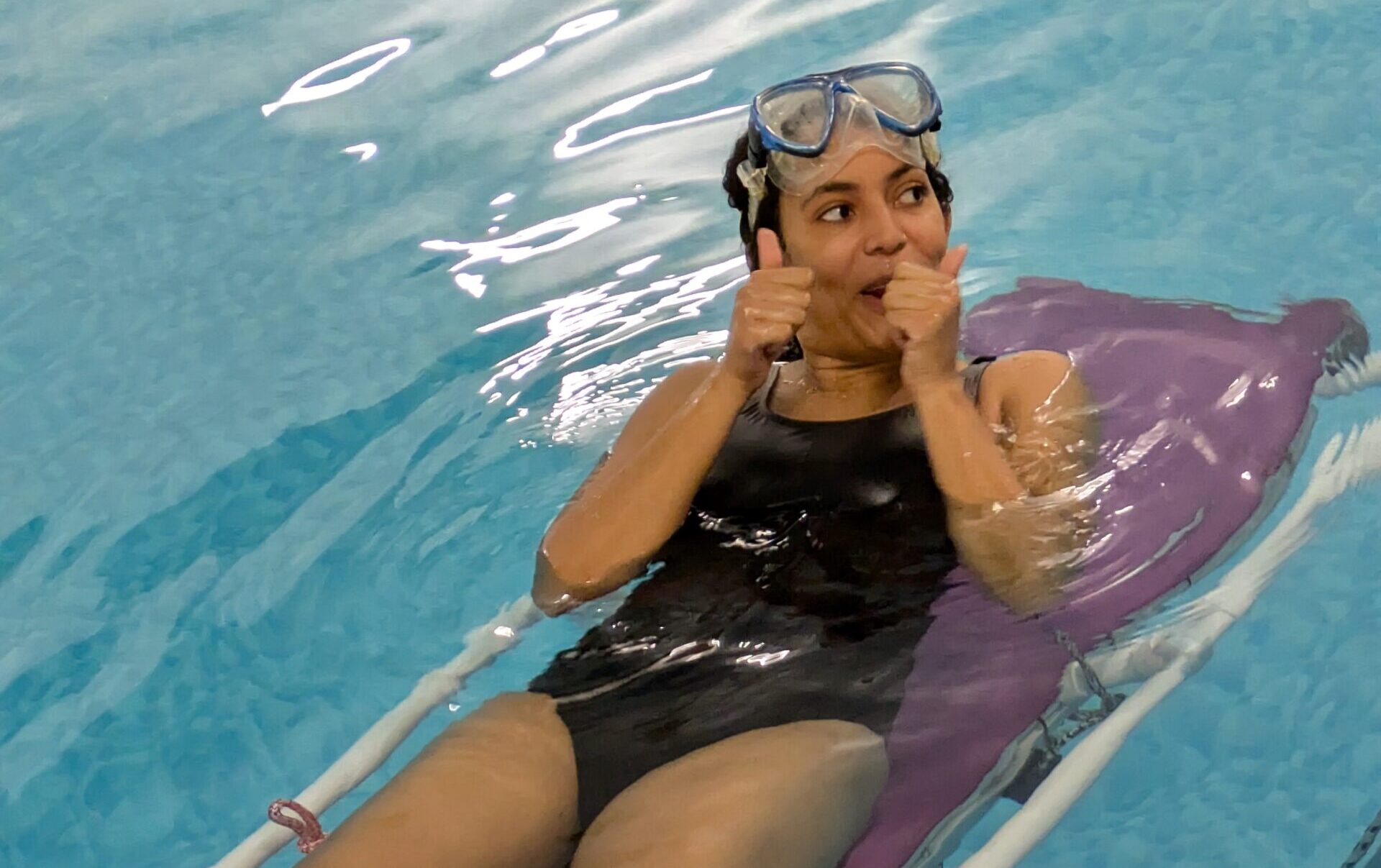
Our team of researchers and swim teachers came together to help over 100 participants from African, Caribbean, and Asian backgrounds find their unique style of floating for their bodies.

Step 1: Measurements

All participants had their basic measurements taken (height, weight, etc.) as well as their BMI (Body Mass Index) and buoyancy using a custom made water bed.

Step 2: 2 Minute Float

After 1-to-1 practice with our float specialists, each participant underwent 2 minutes of unassisted floating. Measurements were taken before, during, and after floating.

Step 3: DEXA Scan

After participants’ time in the water, each received in-depth bone density measurements using a DEXA (Dual-energy X-ray absorptiometry) scan, provided by King’s College London.

While the majority of participants started the research as individuals who were unable or struggled to float, they left the experiment confident and empowered after finding the unique style of floating that works for them.

The Findings

The primary findings from the research project include the following:


Bone density does not predict buoyancy nor the effort required to float.

89 of 101 participants floated unassisted for the 2 minutes.


Confidence and perceived ease of floating improved with practice.


There are multiple floating styles that vary from one participant to another. In other words: everybody floats differently.